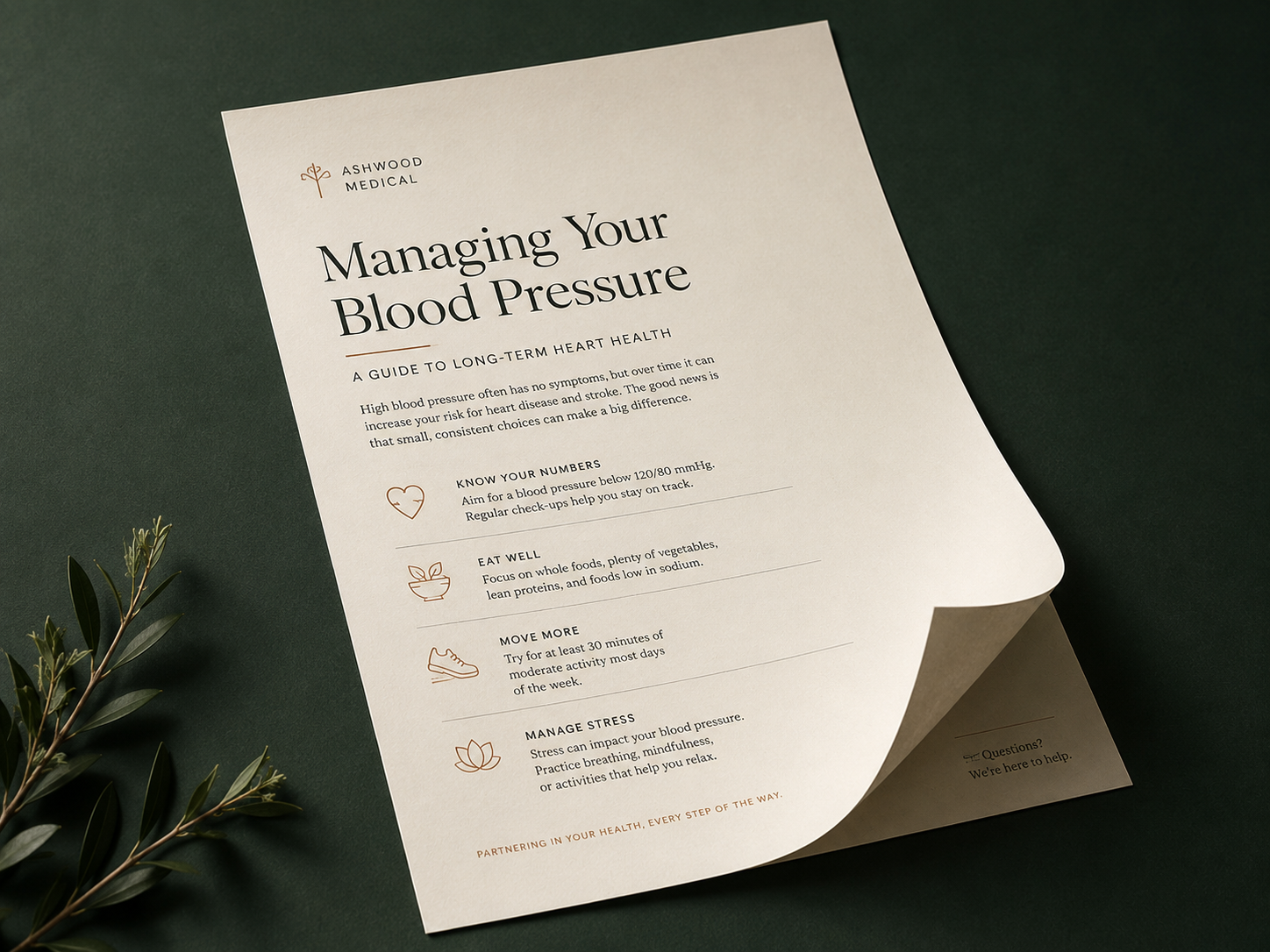

Most clinics can tell me what their waiting-room leaflets say. Almost none can tell me what their discharge instructions say, who wrote them, or when they were last revised. That ordering is exactly backwards.
The one document the patient definitely takes home
A leaflet in a rack is optional. A discharge instruction sheet goes home in a hand, into a bag, onto a kitchen counter, and gets read by whoever is doing the caring — often at the moment something has started to go wrong.
It is also the document most likely to have been produced under time pressure, pasted from a template, and never reviewed by anyone whose job is communication rather than throughput.
The result is predictable. Instructions that assume the reader already understands the diagnosis, that bury the one action that matters, and that describe warning signs in language a frightened person cannot parse at eleven at night.
What a 2026 initiative actually changed
A nurse-led project in the pediatric cardiothoracic intensive care unit at Loma Linda University Children’s Hospital, published in Critical Care Nurse in April 2026, did something unfashionably simple. It assessed caregivers’ health literacy soon after admission and adjusted discharge education to match.
The thirty-day readmission rate following cardiac surgical repair fell from 12.3 percent in 2022 to 10.5 percent in 2023, alongside improved caregiver satisfaction scores.
No new technology. No new staffing model. A measurement taken early, and a document rewritten to fit the person receiving it.
Reading level is the cheapest lever available
The long-standing recommendation is to keep patient materials at or below a sixth-grade reading level. Reviews of discharge instructions keep finding that a large share exceed it, sometimes substantially.
That gap is not caused by clinicians being unable to write simply. It is caused by nobody owning the document. It was inherited, it has always looked like that, and changing it is not anyone’s explicit job.
Assigning that ownership costs less than almost any other quality intervention a practice can attempt, and unlike most of them it does not compete for clinical time at the bedside.
Why this is an easy business case
Readmissions carry direct financial consequences under most reimbursement arrangements, and a measurable reduction attributable to better discharge education is the rare patient-communication project with a number attached to it.
If you need to justify a content budget internally, this is the strongest ground to fight on. Waiting-room leaflets are hard to attribute. Discharge documents sit adjacent to a metric that finance already tracks.
I would treat the published figures as directional rather than as a promise. A single-center pediatric cardiac population is not a general medical ward. But the mechanism — measure literacy, match the document to it — transfers.
What to fix first
Start with the three highest-volume discharge documents in your service, not with a comprehensive rewrite. Put the single most important action in the first line, before any explanation of the condition.
Then write the warning signs as observable events rather than clinical categories. Not ‘signs of infection’ but what the person would actually see, feel, or measure, and exactly who to call.
Finally, date the document and record who reviewed it. That one habit turns an untraceable inherited artifact into something you can maintain.
References used in drafting
‘Out-the-Door, Dinosaur: Assessing Health Literacy to Improve Discharge Education’, a nurse-led quality initiative at Loma Linda University Children’s Hospital published in Critical Care Nurse in April 2026, informed the description of the intervention and the reported readmission figures.
Reviews of language and readability barriers in discharge instructions, and long-standing guidance on sixth-grade reading level targets for patient materials, informed the discussion of reading level.